Executive Summary:
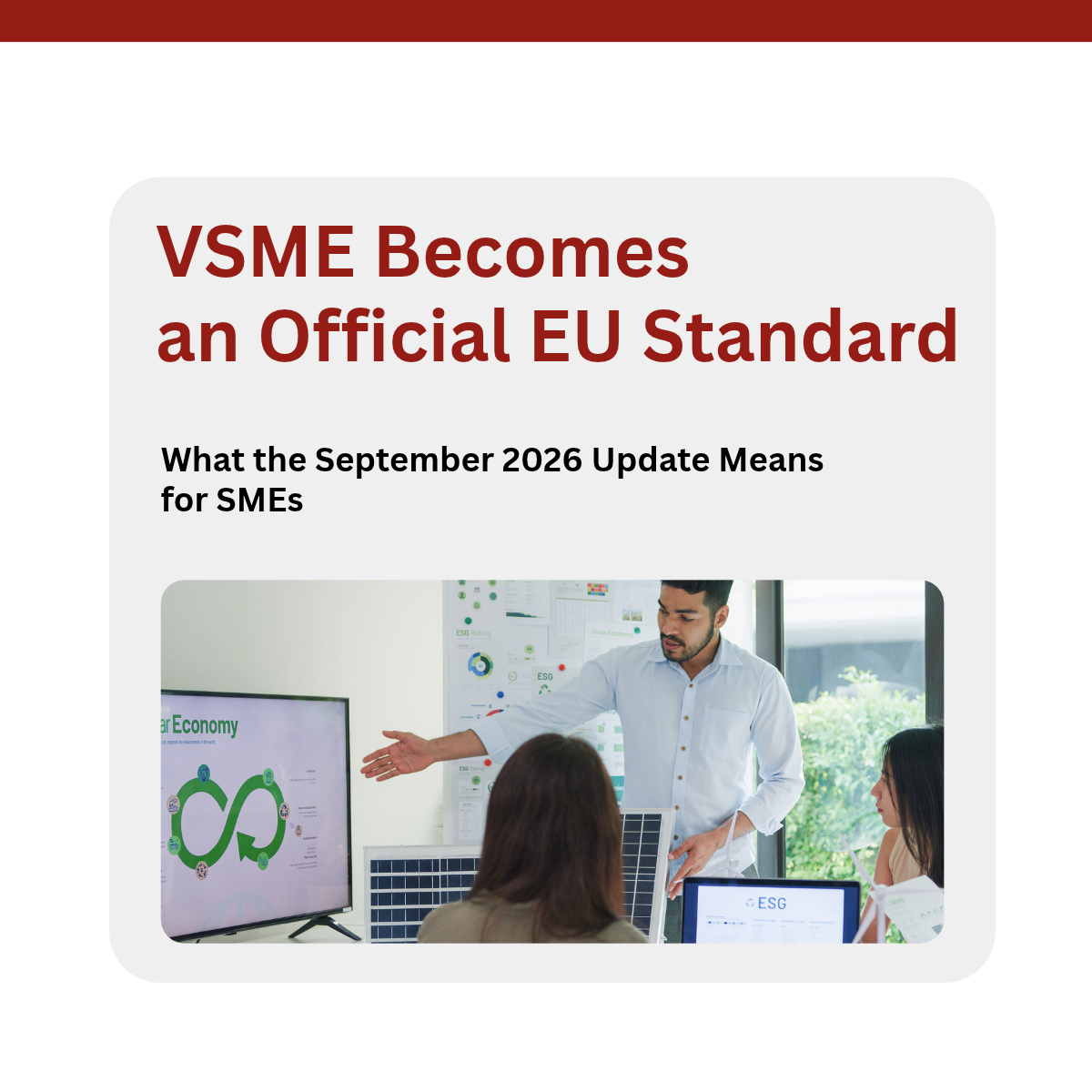
- The VSME framework has officially transitioned from a non-binding European Commission recommendation into an EU Delegated Regulation.
- It introduces a legally binding value-chain cap that protects companies with up to 1,000 employees from excessive corporate ESG data requests while establishing a standardized, proportionate sustainability reporting framework across Europe.
From recommendation to regulation: What Changed in September 2026?
The VSME framework has moved from a Commission recommendation to an EU Delegated Regulation.
Its reporting architecture remains recognisable, but it now has a formal role as a value-chain cap for sustainability information requested from undertakings with up to 1,000 employees.
On 21 September 2026, Commission Delegated Regulation (EU) 2026/1560 was published in the Official Journal of the European Union. The regulation establishes a sustainability reporting standard for voluntary use by undertakings that fall outside mandatory reporting rules.
This is an important change in status. The earlier VSME recommendation offered a common, proportionate framework that smaller businesses could choose to use. The 2026 regulation retains that voluntary reporting purpose while embedding the framework in EU law and linking it directly to the revised corporate sustainability reporting landscape.
The regulation follows the Omnibus I changes adopted through Directive (EU) 2026/470. Those changes reduced the population of undertakings subject to mandatory sustainability reporting and called for a voluntary standard for businesses outside that scope. In this context, VSME is intended to help smaller businesses respond consistently to information needs from corporate customers, banks and investors without reproducing the complexity of full ESRS reporting.
What Is the Value-Chain Cap and How Does It Protect SMEs?
The most critical regulatory change introduced by Regulation (EU) 2026/1560 is the formal value-chain cap.
Under this rule, large companies reporting under mandatory CSRD provisions may not demand sustainability information beyond the cap from value-chain partners that employed an average of 1,000 or fewer employees during the preceding financial year.
The cap is not the entire VSME standard. It consists only of the essential datapoints listed in Annex II of the regulation. The regulation also distinguishes between the cap applicable to undertakings with ten employees or fewer and the cap for undertakings with more than ten employees. This proportionality is designed to prevent the smallest businesses from facing the same data burden as larger organisations.
Value-Chain Cap Proportionality Breakdown:
What Specific Information Does the Standard Cover?
Annex II provides a dedicated list of disclosures that may form part of the value-chain cap. Depending on company size, the list includes selected information from the Basic and Comprehensive Modules, such as:
This list gives SMEs a clearer reference point when customers ask for sustainability information. At the same time, the regulation makes clear that the value-chain cap applies only to information gathering for sustainability reporting under the relevant national laws implementing the Accounting Directive. Requests arising under other EU or national legal obligations may still follow different requirements.
- the selected reporting module and whether the report is individual or consolidated;
- general company information, including legal form, sector, turnover, workforce size and key operating locations;
- total energy consumption and estimated Scope 1 and location-based Scope 2 greenhouse-gas emissions;
- water withdrawal, circular-economy practices, waste generation, recycling and reuse;
- employee numbers by contract type and gender, workplace accident rates, minimum-wage coverage, collective-bargaining coverage and training hours;
- selected information about products, markets and business relationships; and
- human-rights policies, complaints mechanisms and confirmed incidents.
This list gives SMEs a clearer reference point when customers ask for sustainability information. At the same time, the regulation makes clear that the value-chain cap applies only to information gathering for sustainability reporting under the relevant national laws implementing the Accounting Directive. Requests arising under other EU or national legal obligations may still follow different requirements.
What has stayed familiar in the VSME Architecture?
For organisations that have already worked with VSME, the basic architecture remains largely familiar. The standard continues to use two modules: Basic Module and Comprehensive Module.
The subject matter also remains aligned with the established VSME approach: energy and emissions, pollution, biodiversity, water, circular economy and waste, workforce characteristics, health and safety, remuneration, training, human rights, anti-corruption and selected governance information. Scope 3 emissions remain a topic to consider where relevant rather than a universal core requirement.
- B1-B11: general information plus core environmental, social and business-conduct metrics. It is the target approach for micro-undertakings and the minimum foundation for other users.
- C1-C9: additional disclosures designed to meet the information needs of banks, investors and corporate clients.
- The Basic Module must be completed first.
The subject matter also remains aligned with the established VSME approach: energy and emissions, pollution, biodiversity, water, circular economy and waste, workforce characteristics, health and safety, remuneration, training, human rights, anti-corruption and selected governance information. Scope 3 emissions remain a topic to consider where relevant rather than a universal core requirement.
Timing and legal effect
- Entry into Force: The regulation entered into force on the third day following publication in September 2026 (on September 24, 2026).
- Effective Date for Value-Chain Cap: Applicable to financial years beginning on or after 1 January 2027.
- Audit & Assurance: The regulation confirms that voluntary reporters are not required to obtain third-party audit or assurance over their VSME disclosures.
Digital tools and Czech-language availability
EFRAG supports implementation with a digital ecosystem comprising the Excel-based VSME Digital Template. Updated versions, along with a migration tool and explanatory note, are scheduled for Q4 2026 to reflect the Voluntary Standard adopted in July 2026.
Based on information presented at EFRAG's VSME outreach event on 9 October 2026, a major release is planned for November 2026. The release is expected to incorporate the changes introduced by the delegated act and add further features. The online platform and supporting digital template are also expected to be updated by the end of 2026 to include Czech-language availability. For Czech SMEs and advisers, this should make the reporting process easier to navigate and reduce reliance on English-language instructions.
Why this matters for EcoVadis and supplier assessments
For companies participating in EcoVadis or responding to customer ESG questionnaires, the VSME regulation creates a stronger common reference point. Its disclosures overlap with many recurring assessment areas, including environmental performance, labour and human rights, ethics, anti-corruption and supply-chain practices.
A well-organised VSME data set can therefore support several business needs at once:
1. voluntary sustainability reporting,
2. customer information requests,
3. financing conversations and preparation for sustainability ratings.
It will not automatically replace every proprietary questionnaire, but it can provide a consistent evidence base and help businesses identify gaps before requests arrive.
5 Practical Action Steps for SMEs
- Confirm whether the Basic Module is sufficient or whether business partners are likely to require selected Comprehensive disclosures (e.g. for EcoVadis, it’s recommended to use Comperhensive module in order to qualify for higher score results).
- Map existing sustainability evidence against B1-B11 and identify unavailable or weakly documented datapoints.
- Create clear ownership for energy, emissions, workforce, health and safety, ethics and human-rights information.
- Review incoming customer questionnaires against the Annex II value-chain cap where the request supports mandatory sustainability reporting.
- Monitor the Q4 2026 EFRAG release and migrate reporting data to the updated digital template, including the Czech-language version when available.
Alternatively, use the Flagship Platform to assign data-collection responsibilities, gather information, and view results in clear, visually engaging dashboards.
Frequently Asked Questions (FAQ)
Is VSME mandatory for small and medium-sized businesses?
No. VSME remains a voluntary reporting standard. However, it acts as a legal ceiling for what large, regulated companies can require from SMEs in their supply chain, protecting smaller businesses from excessive reporting demands.
Do we need an external auditor to verify our VSME report?
No. Delegated Regulation (EU) 2026/1560 explicitly states that companies applying the voluntary standard are not required to obtain independent assurance over their reported data.
How does VSME help improve our EcoVadis rating?
VSME data directly overlaps with EcoVadis criteria (such as Scope 1 & 2 carbon footprint, workplace safety statistics, or convictions and sanctions for corruption and bribery). Completing the Comprehensive Module provides the precise evidence base needed to achieve higher scores on EcoVadis supplier scorecards.
Conclusion
The September 2026 update is best understood as a regulatory elevation with targeted refinements rather than a complete redesign. VSME remains voluntary for eligible undertakings and retains its Basic and Comprehensive Modules. What has changed is its legal standing, its scope of application up to the 1,000-employee threshold and its new role as the formal value-chain cap.
For SMEs, the practical opportunity is to use one proportionate reporting structure to organise sustainability information, support customer and finance requests, and prepare for assessments such as EcoVadis. The planned digital-tool update, including Czech-language availability by the end of 2026, should make that process more accessible for Czech users.
Ready to Simplify Your ESG Reporting?
Navigating new EU sustainability regulations doesn't have to be overwhelming. Whether you need to assess your readiness for the VSME standard, streamline data collection, or boost your EcoVadis score, our team of ESG experts is here to support you every step of the way.
- Discover how we can help: Visit our ESG Reporting Services page to explore our tailored solutions and digital toolkits.
- Book a Free 30-Minute Consultation: Schedule a 30-minute call with our team to discuss your specific reporting needs and build a clear, hassle-free roadmap.
About the author
Eliška Jaros is a Sustainability Strategist at Flagship Impact
She specializes in corporate sustainability, with her primary expertise in guiding clients through the entire ESG reporting process. Eliška helps businesses correctly interpret reporting standards, set up internal data-collection processes, and prepare comprehensive sustainability reports that drive strategic value and ensure compliance. Her broad methodological background also includes extensive experience with other sustainability frameworks; she has successfully guided nearly 20 companies through the EcoVadis rating process and collaborated on securing the prestigious B Corp certification for a client in the hospitality sector.