All it takes is opening the news and you get the feeling that sustainability is weakening. Political disputes. Criticism of ESG. Regulatory changes in the EU. The impression is that the topic is running out of steam. But inside companies, something very different is happening.
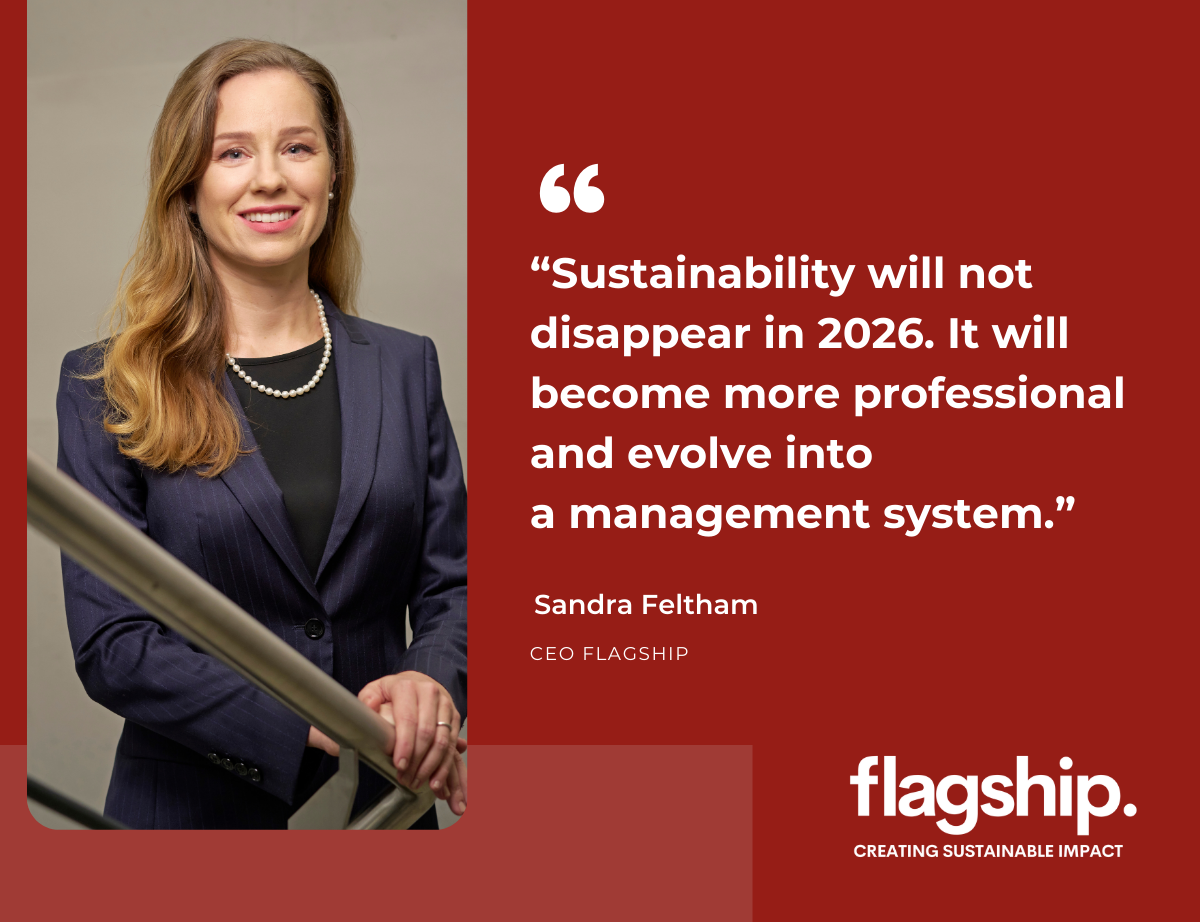
From our work at Flagship, we clearly see that sustainability in 2026 is not disappearing. It is becoming professionalised. It is no longer about promises, visions and presentations. It is becoming a management system. About data, processes, accountability and decision-making.
In Europe today, sustainability is entering the same space as finance, risk management or compliance. And companies that have understood this are already playing a very different game from those that “just report”.
On the projects we deliver at Flagship, this difference is already very clear. And in 2026, it will be even more visible.
1. Europe is not retreating. It is recalibrating the pace.
Yes, European regulation is changing. Yes, CSRD and ESRS are being simplified and timelines adjusted. But this does not mean a change in direction.
The European Union has sent a clear signal: sustainability remains part of economic governance. It is just no longer meant to be theoretical. It is meant to work.
2026 will not be a year of pause. It will be a year of consolidation:
- refining approaches to double materiality,
- stabilising ESG data,
- clearly defining governance,
- preparing for auditability and control.
From our experience, we see that companies waiting for “final rules” are losing time. Those building solid foundations today will benefit from future simplification.
2. Double materiality is not an obligation. It is one of the strongest management tools.
Double materiality analysis is often seen as a bureaucratic exercise. In reality, it is one of the most powerful strategic management tools companies have.
In our practice, it is repeatedly confirmed that companies who do it properly gain something most companies lack: clarity about what truly drives their business.
In 2026, mature organisations do not ask: “Do we have to report this?” They ask: “How does this topic affect our strategy, margins, risks, supply chain and long-term value?”
Well-designed double materiality:
- supports strategic decision-making,
- helps prioritise investments,
- simplifies risk management,
- connects sustainability with the business.
On Flagship projects, we see this very clearly: those who do it only for CSRD redo it every year. Those who embed it into management save time, money and nerves.
3. There are enough reports. What is missing is credibility.
Almost everyone has an ESG report today. That no longer impresses anyone.
The difference between companies in 2026 will be whether they:
- understand where their data comes from,
- can substantiate it,
- can repeat the process next year,
- stand up to audit scrutiny.
In daily work with clients, we see a clear shift: from “we have data” to “we stand behind it”. And this is exactly where sustainability finally moves from communication to management discipline.
4. Sustainability is no longer justified morally. It is justified economically.
The language of corporate leadership has changed. And that is a good thing.
Today, sustainability is discussed in the context of:
- costs and their stability,
- energy risks,
- supply chain security,
- customer and investor expectations,
- reputational and legal impacts.
In conversations with leadership teams we work with at Flagship, sustainability is no longer “the right thing”. It is about margins, resilience and long-term value. In 2026, sustainability is a rational business decision.
5. Global regulation is fragmenting. But companies are creating chaos themselves.
While Europe is standardising, the world is moving in different directions. And many companies respond by managing sustainability country by country. That is expensive. Inefficient. And risky.
A functional 2026 model is built on:
- one internal data model,
- clear governance,
- consistent definitions,
- local mapping to specific regulations.
From Flagship projects, it is repeatedly confirmed that this approach dramatically reduces cost, complexity and regulatory risk. At the same time, it prepares companies for the next changes to come.
6. Suppliers: where sustainability becomes market reality
Sustainability is moving into procurement. Not as a questionnaire. As a commercial decision criterion.
Companies we work with on supplier engagement already see that:
- some suppliers are losing contracts,
- others are dropping off preferred lists,
- risk is no longer being tolerated.
For suppliers, sustainability becomes part of sales.
For buyers, it becomes a risk-management tool.
This is very practical, very real change.
7. Greenwashing is no longer marketing. It is governance.
Today, greenwashing risk is not carried by marketing. It is carried by:
- legal teams,
- company leadership,
- supervisory bodies.
In our practice, the most exposed companies are those without clear processes, accountability and approval mechanisms.
In 2026, the winners will be companies that:
- know exactly what they can communicate,
- have evidence for every claim,
- have clear approval processes.
It is not about saying less.
It is about saying only what can be defended.
8. Digitalisation: without it, it will not work. Full stop.
Manual sustainability management does not scale. And it never will.
Spreadsheets and emails fail when:
- reporting is annual,
- data is audited,
- suppliers are involved,
- management wants clarity, not chaos.
On almost every Flagship project, digitalisation becomes the turning point.
In 2026, digital tools become:
- the backbone of ESG data,
- the link between sustainability, finance, procurement and risk management,
- the foundation of repeatability, control and decision-making.
The question is no longer whether to digitalise. The question is how fast – and how smart.
Conclusion
Sustainability in 2026 is not about trends. It is about how companies are run.
From our work at Flagship, we see that companies who succeed do not start with a report. They start with three questions:
- What is truly material for our business?
- What data do we need to manage it?
- And who is accountable?
Companies answering these questions today gain a clear advantage in 2026. Not because they report more, but because they are able to manage sustainability – just like finance, risk or procurement. They use double materiality as a management tool, work with verifiable data and have digital processes that are controllable.
The competitive advantage of 2026 will not be ambition.
It will be the ability to execute.
It will be the ability to execute.